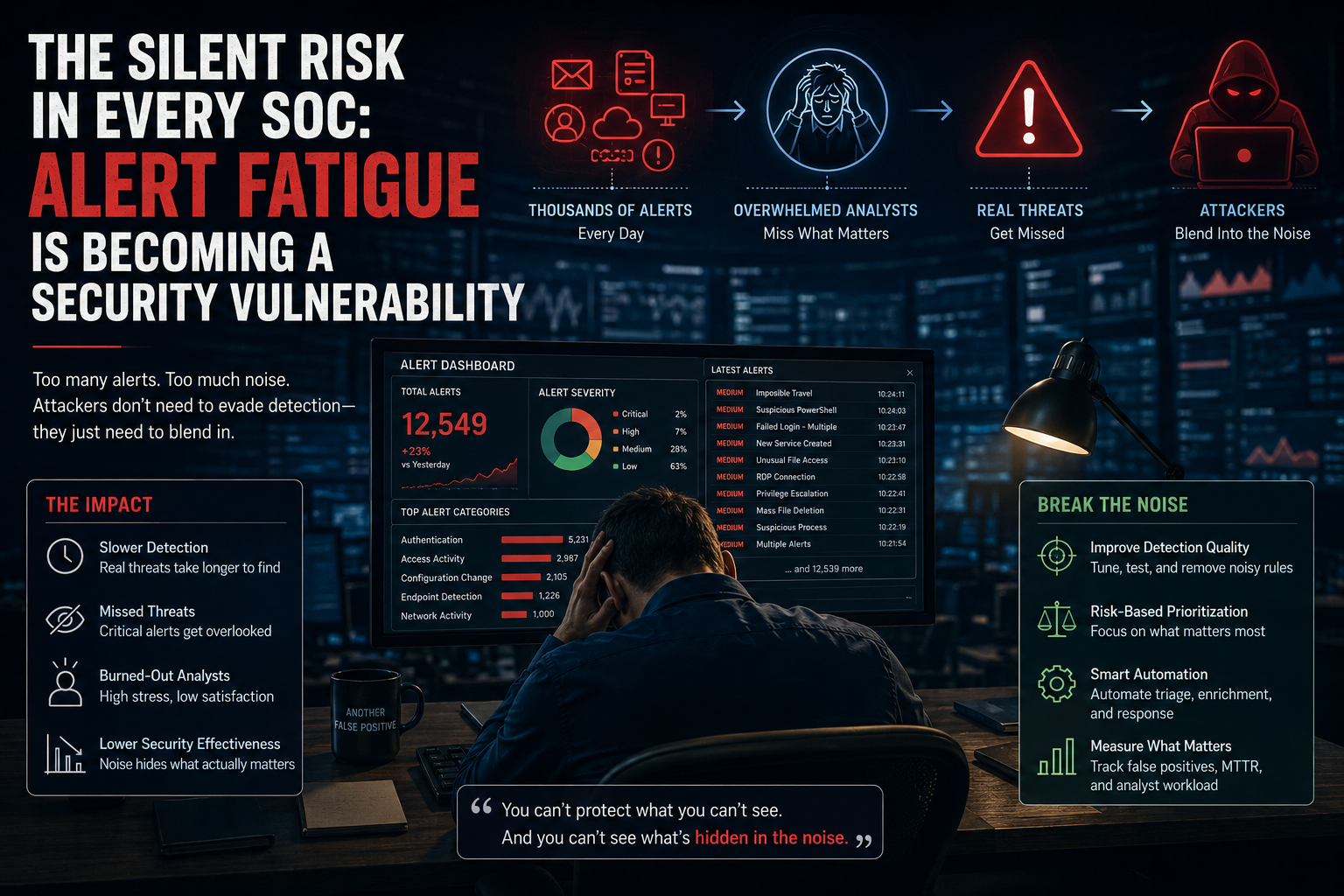
The Silent Risk in Every SOC: Alert Fatigue Is Becoming a Security Vulnerability
Executive Summary
Security Operations Centers (SOCs) have never had more visibility into their environments. Modern organizations deploy endpoint detection and response platforms, SIEMs, cloud security tools, identity monitoring solutions, and threat intelligence feeds that generate millions of security events every day. While this visibility is essential for detecting threats, it has created a new challenge: analysts are increasingly overwhelmed by the volume of alerts they must investigate.
Alert fatigue occurs when security teams are exposed to more alerts than they can reasonably process. Excessive false positives, duplicate notifications, and low-priority events can cause genuine threats to be overlooked, delayed, or dismissed. Attackers understand this reality and increasingly design campaigns to blend into the noise rather than evade detection entirely.
This article examines how alert fatigue has evolved into a security vulnerability, how adversaries exploit overloaded SOCs, and what organizations can do to improve signal-to-noise ratios through automation, prioritization, and better detection engineering.
The Silent Risk in Every SOC: Alert Fatigue Is Becoming a Security Vulnerability
For years, cybersecurity teams have focused on improving visibility. Organizations invested heavily in monitoring technologies capable of collecting logs from endpoints, cloud services, applications, networks, and identity providers. The assumption was simple: more visibility would lead to better security outcomes. In practice, however, visibility alone does not guarantee security. Many SOCs now face the opposite problem. Instead of lacking information, they are drowning in it.
Modern security tools generate enormous numbers of alerts, many of which require manual investigation. Analysts are expected to identify genuine threats hidden among thousands of routine events, false positives, and duplicated notifications. As alert volumes continue to grow, the ability to distinguish meaningful signals from background noise becomes increasingly difficult. The result is alert fatigue, a condition that is no longer simply an operational challenge but a genuine security risk.
Understanding Alert Fatigue
Alert fatigue occurs when security analysts become overwhelmed by the volume, frequency, or quality of alerts generated by monitoring systems. When every event appears urgent, it becomes difficult to determine which incidents actually require immediate attention. A typical SOC may receive alerts from multiple security products simultaneously. Endpoint detection platforms identify suspicious processes, identity systems flag unusual login behavior, cloud security tools report configuration changes, and threat intelligence feeds continuously generate matches against known indicators.
Individually, many of these alerts may be legitimate. The problem emerges when analysts must review hundreds or thousands of them during a single shift. Over time, excessive alert volumes create several operational problems. Investigation quality decreases, response times increase, and analysts become more likely to dismiss alerts that appear routine. Even highly skilled security professionals can struggle to maintain effectiveness when exposed to constant streams of notifications.
The Hidden Cost of False Positives
False positives are often viewed as an inconvenience, but their impact extends far beyond wasted analyst time. Every false positive consumes resources. Analysts must review the alert, gather contextual information, assess the risk, document findings, and ultimately close the investigation. When this process is repeated hundreds of times per day, the cumulative cost becomes significant.
More importantly, excessive false positives reduce confidence in detection systems. When analysts repeatedly encounter alerts that prove harmless, they may begin to assume that future alerts are similarly benign. This phenomenon, sometimes referred to as “alert desensitization,” creates an environment where genuine threats can be overlooked. The danger is not merely that analysts miss alerts. The danger is that they become conditioned to expect alerts to be wrong.
Why Attackers Love Noisy Environments
Traditional security thinking often assumes attackers want to remain invisible. While stealth remains valuable, many modern adversaries recognize that complete invisibility is unnecessary. Instead, attackers increasingly focus on blending into existing operational noise. If a SOC receives thousands of alerts daily, generating a handful of additional alerts may attract little attention. Attackers can exploit this reality by performing actions that resemble legitimate administrative activity, generating low-priority detections, or spreading malicious actions across extended periods.
This approach aligns with the growing prevalence of Living-off-the-Land techniques, where attackers leverage legitimate system tools rather than deploying easily identifiable malware. PowerShell, Windows Management Instrumentation (WMI), SSH, scheduled tasks, cloud administration APIs, and remote management tools are frequently used because they already exist within the environment and generate activity that appears normal. When legitimate administration and malicious activity produce similar telemetry, distinguishing between them becomes significantly more difficult.
The Human Factor
Alert fatigue is often discussed as a technical problem, but it is fundamentally a human problem. Security analysts must continuously evaluate risk under time pressure. They are expected to process large amounts of information, make rapid decisions, and maintain constant vigilance against evolving threats. As alert volumes increase, cognitive overload becomes unavoidable. Analysts experience decision fatigue, reduced concentration, and declining effectiveness. Long periods spent reviewing low-value alerts can reduce the attention available for investigating genuinely suspicious activity.
The cybersecurity industry frequently discusses technology gaps, yet many security incidents occur because human defenders simply cannot process the volume of information presented to them. This reality highlights an important truth: security tools do not replace analysts. They compete for analysts’ attention.
Detection Engineering Matters More Than Detection Quantity
Many organizations evaluate security maturity by measuring the number of detections they deploy. While expanding coverage is important, detection quantity alone does not improve security. A detection that generates thousands of false positives may create more risk than a detection that does not exist at all. Poorly tuned rules consume analyst time, reduce confidence in monitoring systems, and contribute directly to alert fatigue.
Effective detection engineering focuses on quality rather than quantity. Security teams should continuously review detection performance, measure false positive rates, identify redundant alerts, and remove rules that provide little operational value. The objective is not to generate more alerts. The objective is to generate better alerts.
Risk-Based Prioritization
One of the most effective strategies for reducing alert fatigue is risk-based prioritization. Not all alerts represent the same level of threat. A failed login attempt on a standard user account differs significantly from suspicious activity involving a privileged administrator account. Similarly, unusual behavior on a development system may present less risk than equivalent activity on a production environment containing sensitive customer data.
Risk-based prioritization combines multiple factors such as asset criticality, user privileges, threat intelligence, business impact, and behavioral context to determine which alerts deserve immediate attention. Rather than treating every alert equally, security teams can focus resources where they matter most. This approach enables analysts to spend less time processing low-risk events and more time investigating activity that could have significant operational consequences.
Automation as a Force Multiplier
Automation is frequently presented as the solution to alert fatigue, but automation alone cannot solve the problem. Automating poorly designed processes simply allows organizations to handle larger volumes of low-quality alerts. The real value of automation lies in reducing repetitive tasks that consume analyst time.
Modern SOC automation platforms can enrich alerts with contextual information, correlate events across multiple systems, gather forensic evidence, and automatically close known benign cases. This allows analysts to focus on investigation and decision-making rather than manual data collection. When implemented effectively, automation acts as a force multiplier that improves analyst productivity without sacrificing visibility. However, automation should support human analysts rather than replace them. Critical security decisions still require human judgment, particularly when dealing with novel threats or complex attack chains.
Measuring What Matters
Many organizations track metrics such as the number of alerts generated, the number of investigations completed, or the number of detections deployed. While these metrics provide operational visibility, they do not necessarily reflect security effectiveness. More meaningful measurements include false positive rates, mean time to triage, mean time to respond, analyst workload, and alert closure quality. These metrics provide insight into whether the SOC is becoming more effective or simply processing larger volumes of data. Security leaders should also assess how much analyst time is spent investigating benign activity. In many environments, reducing unnecessary investigations can have a greater impact on security outcomes than deploying additional monitoring tools.
Conclusion
Alert fatigue is often viewed as an operational inconvenience, but its impact extends far beyond analyst frustration. Excessive alert volumes, poor detection quality, and constant false positives can reduce investigation effectiveness, delay incident response, and create opportunities for attackers to operate unnoticed. As organizations continue expanding their security monitoring capabilities, the challenge is no longer collecting more data. The challenge is ensuring that analysts can effectively act on the data they receive.
The most mature SOCs are not necessarily those with the most alerts or the largest number of detection rules. They are the teams that understand the value of analyst attention and actively protect it. By improving detection quality, implementing risk-based prioritization, and leveraging automation strategically, organizations can reduce alert fatigue and strengthen their ability to identify genuine threats. In an era where security teams face increasing complexity and resource constraints, reducing noise may be just as important as detecting attacks.